Release time : 2026-08-08 Source :Organizing Committee
Sichuan Province has released a new action plan to accelerate the large-scale deployment of new energy freight trucks, targeting a fleet of more than 40,000 vehicles by the end of 2027 while expanding the use of hydrogen fuel cell trucks across the province to support low-carbon freight transport.
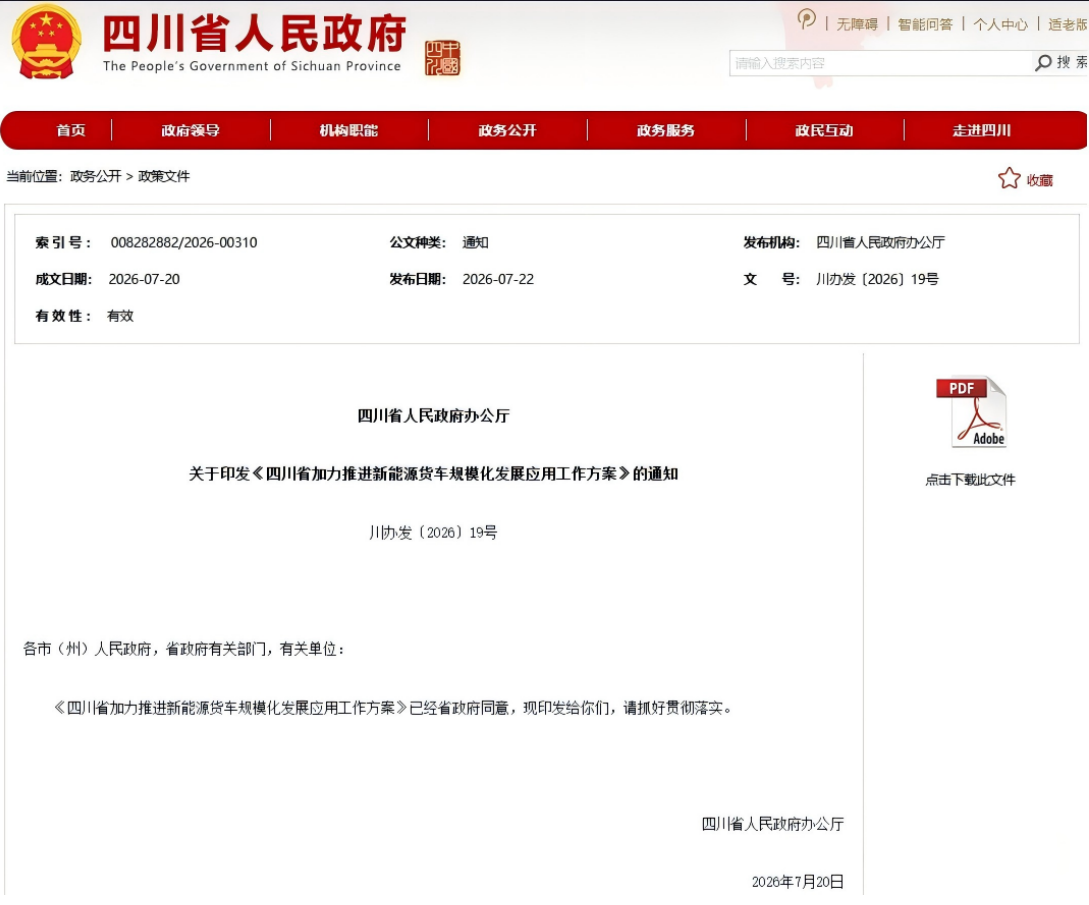
To reduce vehicle acquisition costs, the plan supports the replacement of aging commercial trucks through China's ultra-long special treasury bond program for equipment renewal. Eligible freight operators purchasing new energy trucks through bank loans in 2026 can receive a one-year interest subsidy of 1%, applicable to loans of up to RMB 400,000. Local governments are also encouraged to introduce additional purchase incentives for logistics companies.
Operating incentives will remain in place through December 31, 2027. New energy trucks equipped with electronic toll collection (ETC) systems will continue to receive a 20% discount on provincial expressway tolls, while hydrogen fuel cell trucks will remain fully exempt from provincial expressway tolls. The province will also expand road-access and parking privileges for new energy trucks and strengthen maintenance and service networks for core electric vehicle components.
Sichuan is accelerating the deployment of charging, battery-swapping and hydrogen refueling infrastructure along expressways, logistics parks, industrial parks, mining areas and port zones. The province will also promote integrated solar-storage-charging-and-hydrogen-refueling facilities. Three major zero-carbon freight corridors along the G5 Beijing–Kunming Expressway, G42 Shanghai–Chengdu Expressway, and G65 Baotou–Maoming Expressway are planned, with a target of developing more than 1,000 km of zero-carbon transport corridors by the end of 2027.
Hydrogen mobility is a key component of the province's transport strategy. Sichuan will further upgrade and expand the Chengdu-Chongqing Hydrogen Corridor while gradually developing a series of green hydrogen corridors, including the Sichuan-Tibet Corridor, the Chengdu-Deyang-Meishan-Ziyang Metropolitan Corridor, the Panzhihua-Xichang-Ya'an Corridor, the Chengdu-Deyang-Mianyang-Guangyuan Corridor, the Chengdu-Ziyang-Zigong-Luzhou Corridor, and the Chengdu-Suining-Nanchong-Dazhou Corridor. Hydrogen fuel cell trucks will be promoted across long-haul logistics, industrial transfer operations, construction material and waste transport, and cold-chain logistics.
On the industrial side, Sichuan plans to attract leading new energy truck manufacturers, support the establishment of local research and development centers, and organize regular supply-and-demand matchmaking events connecting vehicle manufacturers, logistics companies, charging and hydrogen refueling infrastructure operators, and financial institutions. Additional measures include land-use support for charging and hydrogen refueling facilities, upgrades to roadside power distribution networks, expanded financing through government bonds and policy-based financial instruments, and strengthened safety monitoring and routine inspections of charging and hydrogen refueling infrastructure.
Exhibitor/Conference Consultation
Contact: Ms. Becky CHEN
Tel: +86 15910580218
Email: becky@cntigerexpo.com
Exhibitor Consultation
Contact: Mr. Lito HU
Tel: +86 13601321637
Email: lito.hu@cntigerexpo.com
Exhibitor Consultation & Media Cooperation
Contact: Ms. Yasmin ZHENG
Tel: +86 13621183385
Email: zhengyaxin@cntigerexpo.com