Release time : 2026-08-06 Source :Organizing Committee
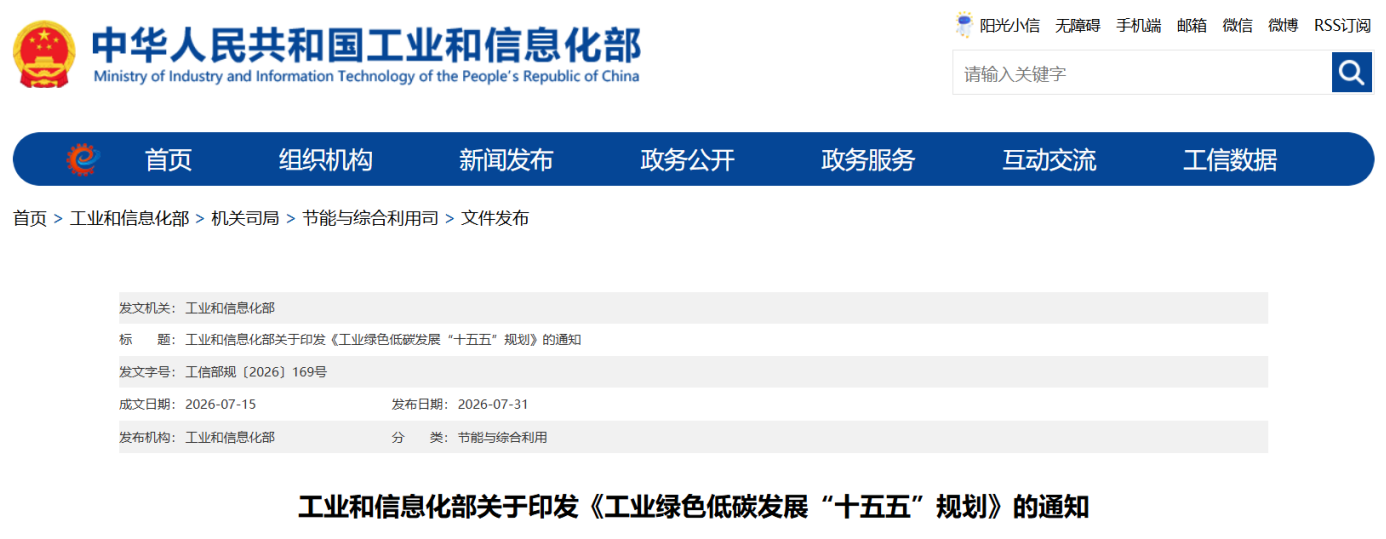
BEIJING — On July 31st, the Ministry of Industry and Information Technology (MIIT) issued the "15th Five-Year Plan for Industrial Green and Low-Carbon Development" (the Plan). The policy framework positions green and low-carbon transformation as a vital mechanism for value creation and upgrading, urging industries and enterprises to align strategies, accelerate voluntary shifts, and cultivate "green productive forces." The Plan prioritizes advanced technological sectors—including new energy equipment, new energy vehicles (NEVs), next-generation energy storage, hydrogen, and energy-saving environmental technologies—to push China's industrial chain toward the mid-to-high end of global value chains.
Under the condition of aligning with national industrial footprint strategies, the Plan encourages resource-rich green energy regions to orderly absorb energy-intensive sectors, including electrolytic aluminium, steel, petrochemicals, photovoltaics (PV), and power batteries. The objective is to extend green energy value chains, promote the utility-scale application of green hydrogen, ammonia, and methanol, and enhance localized off-take capacity for clean power.
Key infrastructure initiatives outlined in the Plan include:
Green Computing Nodes: Building qualified green computing facilities in regions with abundant renewable resources to substantially raise the renewable electricity consumption ratio of new data centers across national computing hubs.
Zero-Carbon Facilities: Establishing a series of zero-carbon factories and zero-carbon computing centers with elevated application rates for green power and green hydrogen, creating scalable and replicable deployment models.
Furthermore, China will advance the deployment of industrial green microgrids integrating solar PV, wind power, heat pumps, battery storage, hydrogen, waste heat/pressure/gas recovery, and smart energy management systems to achieve multi-energy complementary utilization. The Plan encourages enterprises and industrial parks to scale green power adoption via direct green power lines, local renewable integration into incremental distribution networks, and integrated source-grid-load-storage models.
The Plan highlights the expansion of green growth drivers across emerging sectors. It advocates developing the hydrogen industry tailored to regional conditions, focusing on breakthroughs in clean, low-carbon hydrogen production and application technologies. Through pilot demonstration projects, China aims to broaden the commercial integration of clean hydrogen across the industrial and transport sectors.
Exhibitor/Conference Consultation
Contact: Ms. Becky CHEN
Tel: +86 15910580218
Email: becky@cntigerexpo.com
Exhibitor Consultation
Contact: Mr. Lito HU
Tel: +86 13601321637
Email: lito.hu@cntigerexpo.com
Exhibitor Consultation & Media Cooperation
Contact: Ms. Yasmin ZHENG
Tel: +86 13621183385
Email: zhengyaxin@cntigerexpo.com