Release time : 2026-08-03 Source :Organizing Committee
July 28 – Seven Chinese government agencies, led by the Ministry of Industry and Information Technology (MIIT), jointly issued a notice launching the 2026 "Unveil the List and Take Charge" Innovation Challenge Program for the industrial and information technology sectors.
The program covers 24 research themes across six priority areas: future industries, equipment manufacturing, information technology, communications, artificial intelligence, and consumer goods.
Future industries (5 themes): Humanoid robots and embodied intelligence, atomic-level manufacturing technologies, high-performance separation and purification equipment for biomanufacturing, brain-inspired intelligence, and advanced laser manufacturing technologies.
Equipment manufacturing (5 themes): Water-saving technologies and equipment, intelligent manufacturing system solutions, cultural heritage protection equipment, advanced power equipment technologies, and green refrigerant equipment for the automotive industry.
Information technology (5 themes): Industrial software, big data technologies, metaverse technologies, financial information technologies, and virtual reality technologies.
Communications (4 themes): Communications equipment, technologies for high-quality computing infrastructure, data utilization technologies for the telecommunications industry, and innovative cybersecurity technologies for core telecommunications networks.
Artificial intelligence (4 themes): Foundation AI technologies, AI-enabled application technologies, intelligent equipment and products, and enabling technologies.
Consumer goods (1 theme): Chemical fiber finishing agent technologies.
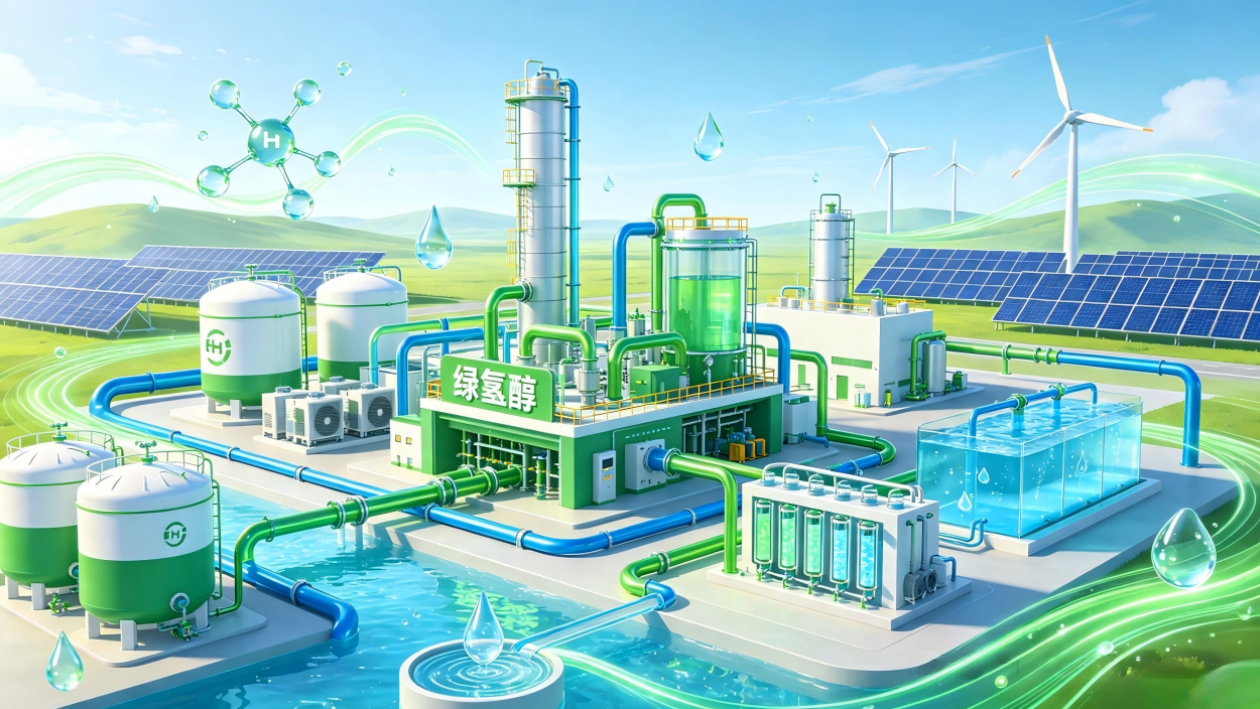
Notably, although hydrogen is not listed as a standalone research theme, key water-saving technologies and equipment for the green hydrogen-to-methanol industry have been included under the water-saving technologies and equipment theme within the equipment manufacturing category.
The initiative targets key challenges facing the green hydrogen-to-methanol industry, including high water consumption, high purification costs, and significant wastewater losses. It calls for research on source-side water conservation, water purification, and circulating water system optimization. The program also encourages the adoption of full-membrane treatment processes to optimize water use and the development of alternative non-conventional water source technologies, with the aim of establishing an integrated technical framework that minimizes water losses, improves purification efficiency, and reduces water consumption and operating costs.
The program further calls for optimization of circulating cooling water system operation and control strategies, the development of an intelligent precision control platform capable of dynamically optimizing water flow, temperature, and chemical dosing, the establishment of a multi-dimensional evaluation system, and the formulation of water-saving technical standards tailored to the green hydrogen-to-methanol industry.
By 2028, the program aims to develop modular water-saving units compatible with multiple water sources, deliver one standardized process package, and demonstrate the technology in at least two representative application scenarios with a combined treatment capacity of no less than 1,000 tonnes per hour.
The treated water is expected to achieve a resistivity of at least 10 MΩ·cm (25°C), a chloride concentration of no more than 2 mg/L, and a silica concentration of no more than 20 ppb, while delivering an annual water-saving rate of more than 18%.
Exhibitor/Conference Consultation
Contact: Ms. Becky CHEN
Tel: +86 15910580218
Email: becky@cntigerexpo.com
Exhibitor Consultation
Contact: Mr. Lito HU
Tel: +86 13601321637
Email: lito.hu@cntigerexpo.com
Exhibitor Consultation & Media Cooperation
Contact: Ms. Yasmin ZHENG
Tel: +86 13621183385
Email: zhengyaxin@cntigerexpo.com