Release time : 2026-08-03 Source :Organizing Committee
CHIFENG, Inner Mongolia — The first phase of Envision Energy’s zero-carbon hydrogen and ammonia project achieved a major construction milestone, as all 12 units of ZHSFPT-66000/35 water-electrolysis hydrogen rectifier transformers—independently developed and manufactured by XD Zhongte Electric(a subsidiary of China Electrical Equipment)—were successfully energized and commissioned. The operational ready state of this core equipment establishes a robust hardware foundation for upcoming hydrogen production system tuning and commercial commissioning.
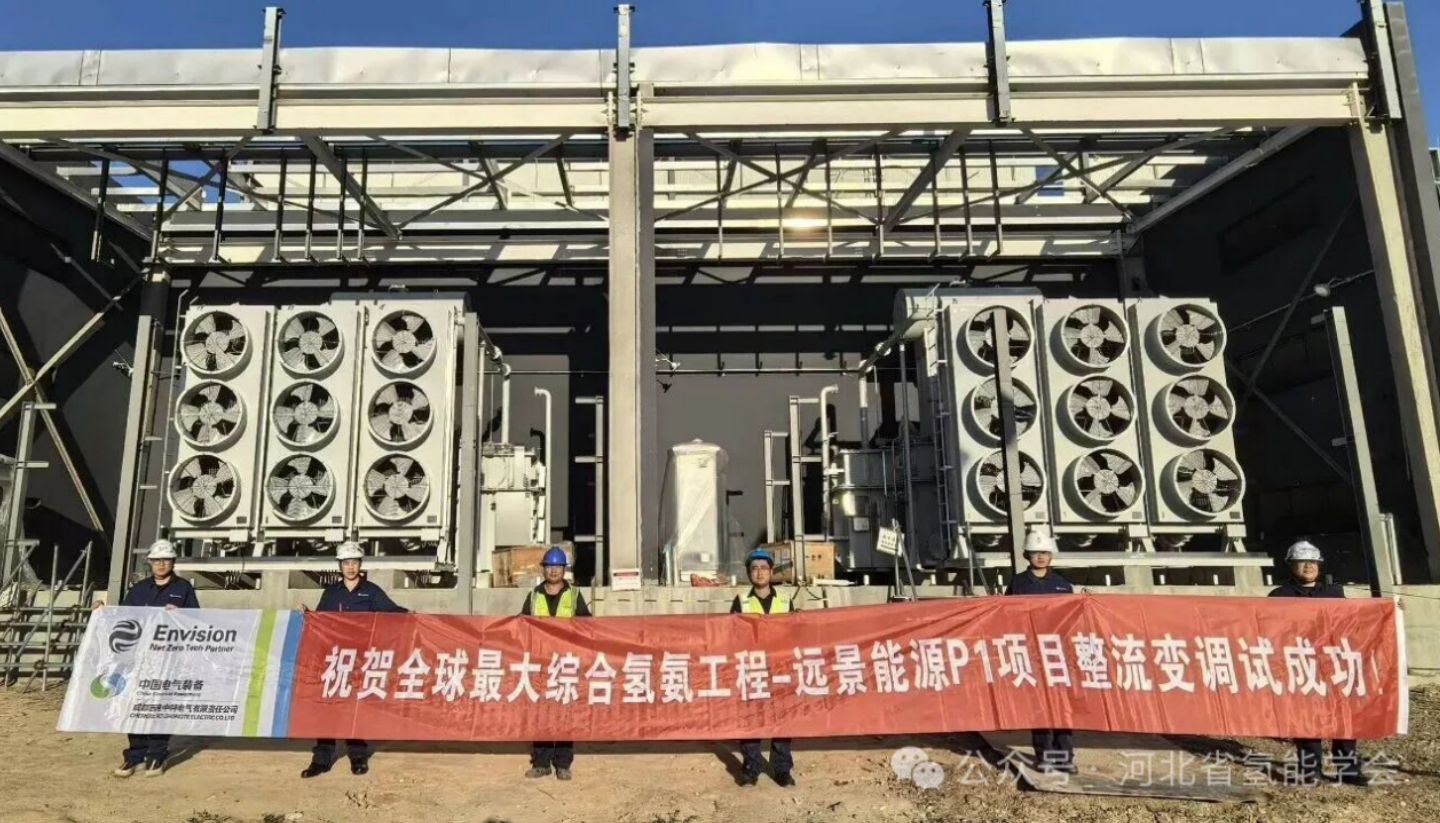
As critical core infrastructure within water electrolysis systems, rectifier transformers convert alternating current (AC) into the direct current (DC) required by electrolyzers. The stable performance of these units is a essential prerequisite for utility-scale green hydrogen production. The successful energization of the full transformer suite confirms that the project’s hydrogen generation block is fully prepared for startup, marking its entry into a new operational phase.
Designed with a planned annual capacity of 1.52 million metric tons of green ammonia, Envision Energy’s Chifeng zero-carbon project stands as the world’s first utility-scale green hydrogen-to-ammonia development planned for commercial operation. The project pioneers an integrated "wind-solar-storage-hydrogen-ammonia-methanol" value chain, utilizing 100% renewable electricity derived from local wind and solar resources throughout the production cycle.
Notably, the project has secured the world’s first Renewable Ammonia Certificate issued by Bureau Veritas, establishing full traceability for the low-carbon credentials of its green ammonia output. This certification clears a critical regulatory and compliance pathway for international export and penetration into global industrial decarbonization markets.
As a state-level zero-carbon demonstration project, the facility integrates the entire value chain from renewable power generation and water electrolysis to green ammonia synthesis. The resulting green ammonia will serve both as a low-carbon chemical feedstock to displace conventional fossil-based ("gray") ammonia and as a zero-carbon fuel across international maritime shipping and thermal power generation sectors.
Exhibitor/Conference Consultation
Contact: Ms. Becky CHEN
Tel: +86 15910580218
Email: becky@cntigerexpo.com
Exhibitor Consultation
Contact: Mr. Lito HU
Tel: +86 13601321637
Email: lito.hu@cntigerexpo.com
Exhibitor Consultation & Media Cooperation
Contact: Ms. Yasmin ZHENG
Tel: +86 13621183385
Email: zhengyaxin@cntigerexpo.com