Release time : 2026-07-22 Source :Hydrogen Energy Industry Promotion Association; FuelcellChina
China's hydrogen pipeline sector has entered a new stage of nationwide expansion after the country's 15th Five-Year Plan for Building a Modern Energy System identified hydrogen transmission pipelines as a key component of national energy infrastructure for the first time. The policy marks China's transition from pilot-scale demonstrations to coordinated nationwide deployment, with simultaneous development of dedicated hydrogen pipelines, hydrogen blending in existing natural gas networks, and infrastructure retrofits.
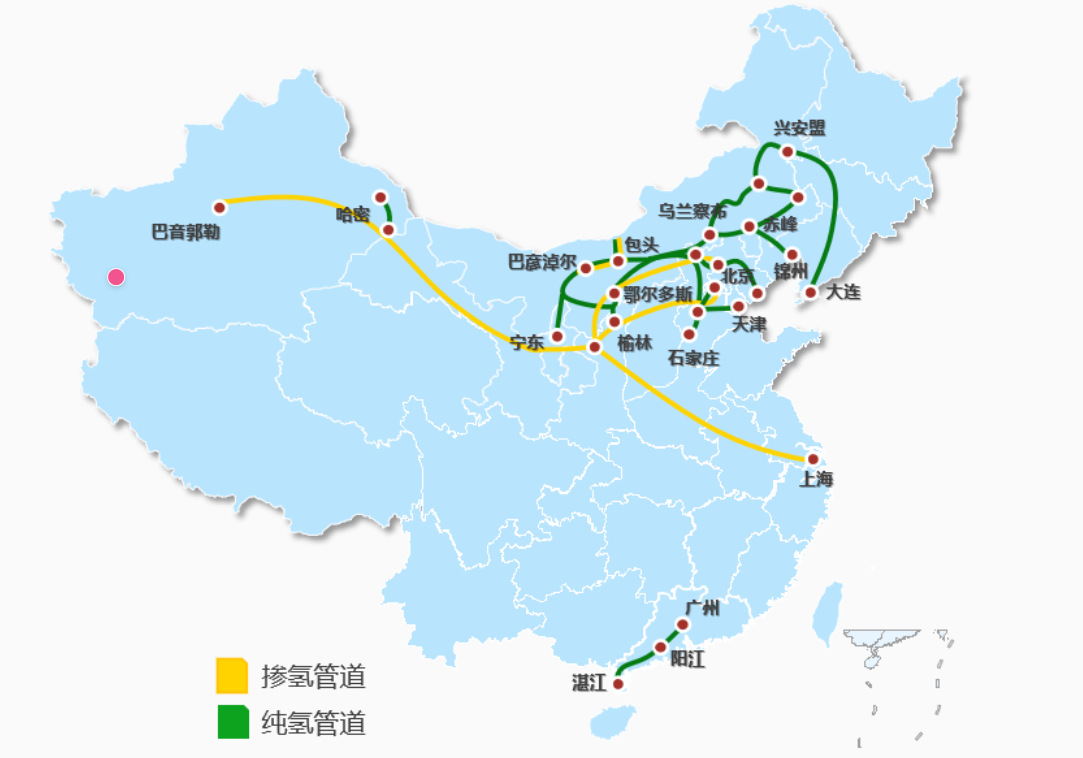
As of June 2026, the combined length of completed, under-construction and planned hydrogen pipelines in China has exceeded 13,000 km, including dedicated pure hydrogen pipelines and hydrogen-blended natural gas pipelines. Stretching from the resource-rich Three-North Region to major demand centers along China's eastern coast, the emerging network is expected to become a critical backbone for large-scale green hydrogen transportation, significantly influencing hydrogen supply costs and industrial development over the coming decade.
1. Stronger National Planning Reshapes China's Hydrogen Pipeline Industry
China's green hydrogen resources are concentrated primarily in the country's resource-rich Three-North Region—Northeast China, North China and Northwest China—while demand is centered in the highly industrialized eastern coastal provinces. This geographical imbalance has made long-distance hydrogen transportation one of the key challenges to scaling the country's hydrogen economy. Dedicated hydrogen pipeline infrastructure is increasingly viewed as the most cost-effective solution for enabling large-scale, cross-regional hydrogen distribution and supporting the national strategy of transporting hydrogen from western production bases to eastern demand centers, as well as from northern regions to southern markets.
The 15th Five-Year Plan for Building a Modern Energy System, jointly issued by the National Development and Reform Commission (NDRC) and the National Energy Administration (NEA), calls for the coordinated development of green hydrogen, ammonia and methanol production bases alongside supporting infrastructure. The plan prioritizes the expansion of hydrogen pipeline networks, encourages the repurposing of underutilized oil and gas pipelines for green methanol transportation, and outlines several landmark cross-provincial projects. These include the Ulanqab–Beijing–Tianjin–Hebei Hydrogen Pipeline, the Ordos–Yulin Hydrogen Pipeline, the Bayannur–Ningdong Hydrogen Pipeline, and feasibility studies for a dedicated green methanol pipeline linking Hinggan League, Songyuan and Dalian. Together, these initiatives establish a dual-track development strategy combining new hydrogen infrastructure with upgrades to existing pipeline assets.
A broader package of national policies is also reshaping the industry's development trajectory. Following the Medium- and Long-Term Plan for the Development of the Hydrogen Industry (2021–2035), which introduced pilot projects for both pure hydrogen and hydrogen-blended natural gas pipelines, the Implementation Plan for Building a Unified National Oil and Gas Pipeline Network designated the West-to-East Hydrogen Transmission demonstration project as a national priority. More recently, the 2026 national conference on oil and gas infrastructure planning called for deeper integration between oil, gas and hydrogen pipeline systems, promoting the evolution of conventional oil and gas infrastructure into integrated multi-energy pipeline networks.
Collectively, these policies are driving three fundamental shifts across China's hydrogen pipeline sector:
Dedicated hydrogen pipelines are primarily being developed as newly built transmission corridors, while hydrogen blending projects leverage existing natural gas infrastructure through pipeline retrofits. Geographically, pure hydrogen pipelines are concentrated in North and Northeast China, where abundant renewable energy resources support large-scale green hydrogen production. These pipelines are designed to transport surplus green hydrogen from Inner Mongolia to major demand centers in the Beijing-Tianjin-Hebei region. Meanwhile, hydrogen blending projects make use of national trunk gas pipelines—including the West-to-East Gas Pipeline and the Shaanxi-Beijing Pipeline System—to establish long-distance hydrogen transportation routes linking western production regions with major cities such as Beijing and Shanghai.
China currently has 13 operational hydrogen pipelines with a combined length exceeding 425 km, according to the Hydrogen Industry Branch. These include approximately 167 km of dedicated pure hydrogen pipelines and 261 km of hydrogen-blended pipelines, with a combined annual hydrogen transport capacity approaching 330,000 metric tons. The highest pipeline design pressure reaches 6.3 MPa.
Most operational pipelines are relatively short industrial hydrogen transmission lines measuring less than 100 km in length. The Baotou-Linhe Hydrogen-Blended Pipeline is currently the only project exceeding the 100-km mark. Project development and operation remain largely dominated by major state-owned energy companies, particularly China National Petroleum Corporation (CNPC) and China Petroleum & Chemical Corporation (Sinopec).
Major Projects Under Construction
Several flagship hydrogen pipeline projects made substantial progress during 2026, signaling China's transition from demonstration-scale deployment to large-scale infrastructure development. Key projects include:
These projects represent the next phase of China's hydrogen infrastructure strategy, expanding pipeline capacity beyond localized industrial applications toward long-distance, cross-regional hydrogen transportation. As additional trunk pipelines move into construction and operation, a nationwide hydrogen transmission network is expected to gradually take shape, providing critical infrastructure for the large-scale commercialization of green hydrogen across China.
3. Technology Advances and Standards Development Strengthen China's Hydrogen Pipeline Sector
China is accelerating technological innovation and standards development for hydrogen pipeline infrastructure, laying the foundation for large-scale commercial deployment. The industry has entered a critical stage where advances in engineering capabilities are being supported by an increasingly comprehensive regulatory and technical standards framework. Together, these developments are strengthening the country's ability to build and operate long-distance hydrogen transportation networks.
Technology Progress
China's hydrogen pipeline technologies have progressed from laboratory research to engineering-scale validation, establishing two complementary technical pathways: dedicated pure hydrogen pipelines and hydrogen-blended natural gas pipelines.
Dedicated Pure Hydrogen Pipelines
Significant progress has been made in both pipeline materials and critical equipment, providing the technical foundation for long-distance hydrogen transmission.
Pipeline Materials
China has achieved stable production of X60-grade hydrogen-resistant steel, while X80-grade materials have completed preliminary technical validation and are being developed for future high-performance applications. In terms of pressure capability, 4 MPa pipeline materials have already been deployed in multiple demonstration projects, while domestically developed 10 MPa pipeline materials represent the highest pressure class currently available for engineering applications in China.
Key Equipment
Domestic manufacturers have also made notable advances in hydrogen transmission equipment. CIMC Enric has developed a hydrogen pipeline compressor with a single-unit capacity of 9,000 Nm³/h, offering high throughput, high-pressure operation and a wide operating range. Meanwhile, PipeChina has independently developed a real-time hydrogen pipeline leak detection and early-warning system capable of continuously monitoring hydrogen concentrations along pipeline routes, enhancing operational safety and reliability.
Hydrogen blending in existing natural gas networks has completed engineering validation at low blending ratios and is now progressing toward medium- and high-ratio applications.
Years of demonstration projects have confirmed that hydrogen blending ratios of up to 10% can generally be accommodated by conventional natural gas pipelines, associated equipment and end-use appliances without major modifications.
Research has now expanded to higher blending levels. Companies including Zhejiang Energy Group and PipeChina have conducted pilot projects with hydrogen blending ratios of up to 30%, while the Ningdong Natural Gas Pipeline in Ningxia has achieved stable continuous operation at a 24% hydrogen blending ratio, providing valuable operational experience for future commercial deployment.
Alongside technological progress, China is rapidly expanding its hydrogen pipeline standards system. A three-tier framework has gradually taken shape, with national standards establishing baseline technical requirements, industry and association standards providing application-specific guidance, and enterprise standards supporting project implementation and engineering practices.
Several key national standards have recently been released, including:
These standards provide technical guidance covering pipeline materials and general engineering design, filling important gaps in China's national standards system for hydrogen pipeline infrastructure.
Industry standards continue to expand in parallel with national specifications. Documents such as:
offer engineering guidance for long-distance transmission systems, chemical industrial parks and industrial hydrogen applications, complementing the national standards with more scenario-specific technical requirements.
Enterprise Standards
At the enterprise level, PipeChina has introduced a comprehensive engineering technology and standards system covering the entire project lifecycle—from material selection and route design to welding, commissioning, operation and maintenance. This represents an important step toward establishing standardized engineering practices for long-distance, large-scale pure hydrogen pipeline projects in China.
Methanol Pipeline Development
While dedicated methanol pipeline infrastructure in China remains at an early stage, the sector is making steady progress through the repurposing of existing pipeline assets. Current methanol pipelines are primarily short-distance facilities serving industrial plants, with a combined length of less than 100 km. However, sequential transportation of methanol through existing oil product pipelines has emerged as a promising solution, offering lower investment costs and shorter deployment timelines than building entirely new infrastructure.
According to partial statistics from the Hydrogen Industry Branch of the China Industrial Development Promotion Association, China has three operational methanol pipelines with a combined length of more than 65 km and an annual transport capacity exceeding 1 million metric tons. These projects provide an important foundation for expanding methanol logistics as demand for low-carbon fuels continues to grow.
A major milestone was achieved in July 2026, when PipeChina completed China's first field demonstration of long-distance sequential methanol transportation through a refined oil pipeline. The successful trial demonstrated the technical feasibility of integrating methanol transportation into the country's existing oil pipeline network and is expected to support the future large-scale distribution of green methanol.
Outlook
Although China's hydrogen pipeline industry is still in the early stages of development, momentum is building rapidly. Strong policy support, continued technological innovation, an expanding standards framework and growing market demand are collectively accelerating the transition from pilot projects to nationwide deployment.
During the 15th Five-Year Plan period, landmark projects—including the Ulanqab–Beijing–Tianjin–Hebei Hydrogen Pipeline—are expected to enter commercial operation, establishing hydrogen pipelines as critical infrastructure for transporting green hydrogen across regions. A more extensive transmission network will improve the efficiency of hydrogen distribution, facilitate the integration of renewable energy resources and support the development of a more competitive hydrogen economy.
Looking ahead, China's strategy of combining new pipeline construction with the retrofitting of existing oil and gas infrastructure, while supporting multiple hydrogen-related energy carriers—including pure hydrogen, hydrogen blends and green methanol—is expected to create a more flexible and resilient transportation network. As this network continues to expand, it will provide a strong foundation for the large-scale commercialization of hydrogen and contribute to the country's broader transition toward a modern, low-carbon energy system.
Exhibitor/Conference Consultation
Contact: Ms. Becky CHEN
Tel: +86 15910580218
Email: becky@cntigerexpo.com
Exhibitor Consultation
Contact: Mr. Lito HU
Tel: +86 13601321637
Email: lito.hu@cntigerexpo.com
Exhibitor Consultation & Media Cooperation
Contact: Ms. Yasmin ZHENG
Tel: +86 13621183385
Email: zhengyaxin@cntigerexpo.com